1. Site Selection for the Blessed Mother’s Mountain
As the number of pilgrims attending the overnight prayer meetings continued to grow, the small chapel at the Blessed Mother’s House could no longer accommodate them. The faithful gathered in ever greater numbers, drawn by reports of grace and healing, yet the space proved insufficient for their devotion.
In response, efforts were made to find new land for a larger place of prayer. On July 9, 1992, Julia Kim was shown in a vision a piece of land on a mountain that Jesus indicated could be used for this purpose. Attempts were made to purchase the property, but the owner refused to sell, no matter how much money was offered, as he had decided to use the land for duck farming. Despite this setback, Julia devoted time each day to searching for suitable land, though none seemed right.
On July 27, 1992, Julia Kim, Fr. Aloysius Chang, and several supporters decided to visit the owner of the duck farm again. Strangely, their car struggled to climb the steep road from the reservoir, even after repeated attempts. But after sprinkling holy water and praying the exorcism prayer, the fragrance of roses suddenly filled the air, and the car ascended with ease.
When they reached the destination, however, they found the land already cultivated. Disappointed, they concluded that the purchase was impossible and prepared to leave. At that moment, Julia encouraged them, saying, “If it is God’s will, He will provide a way.” With renewed faith, they sprinkled holy water and prayed earnestly, asking the Lord—who makes all things possible—to change the landowner’s heart and allow the land to be offered for His work.
2. Purchase of the land for the Blessed Mother’s Mountain
The Lord graciously answered their prayers. On August 25, 1992, the landowner agreed to sell 7,000 pyeong (23,100 m²) of land, which he had previously cleared to build a large duck farm, at a reasonable price. Had it been purchased earlier, the clearing would have been a heavy burden, but the Lord turned what seemed unfavorable into good.
When the decision was made to establish the Blessed Mother’s Mountain, many objected, saying, “There is no water here, so it is absolutely impossible.” Julia Kim, however, dismissed their concerns with faith, declaring, “This is the place the Lord has shown, so He will make it happen.”
Before purchasing the land, Julia had hoped for a site with a reservoir or a large stream. Just before reaching the Blessed Mother’s Mountain, she noticed a small pond-like reservoir on the left side. On August 25, 1992, after acquiring the land, Julia prayed, “Jesus, we wish the reservoir were a bit bigger, but it is better than having none. We will consider it as if there is a large reservoir.”
Then, on September 14, 1992, the city unexpectedly raised the water level of the reservoir by six meters, making it large enough to float boats. The faithful were filled with awe at the Lord’s loving consideration, who not only knows the desires of our hearts but also answers prayers in ways beyond imagination.
3. Construction of the Blessed Mother’s Mountain
(1) Spring of Grace
On the early morning of August 27, 1992, Julia Kim received a vision during prayer. She saw the Blessed Mother carrying a heavy load of laundry—balanced on her head, held in both hands, and even pushed with her feet—as she climbed a steep mountain. At a certain spot, clear water suddenly began to flow from above, forming a large stream.
The Blessed Mother began washing the clothes in the water, while countless people below drank from the stream, bathed in it, and joyfully played, splashing around. At daybreak, Julia Kim, Father Aloysius Chang, and several companions went to the place shown in the vision. They discovered it was on the very land purchased just two days earlier. At that moment, the Blessed Mother gave Julia a message:
“My extremely beloved daughter! As I have prepared at this place through you, a little soul, the spring of Mary’s Ark of Salvation so that all the children in the world may drink from it, immerse themselves in it, and wash themselves with it—dig the spring without delay. This Mother of yours will call all the children in the world to this place, to cleanse them of the stains of the secular world, of pride and evil habits, and to heal their sick souls and bodies.
I will open what has been clogged so that they may lead a new life of resurrection. As I do not want even a single soul to be condemned and lost, I will allow even the gravest sinners to come to the spring of Mary’s Ark of Salvation, to drink, to bathe, and to repent. Thus, I will heal their souls and bodies.”
Julia began digging the spot with her bare hands. Each time she dug, water surged up with a splashing sound, rising about 30 cm. This happened seven times, and on the eighth, the streams merged into one and flowed down as a continuous stream. In this way, the promise Jesus had made on January 18, 1990—“In the not too distant future, through My Mother, I will give you a miraculous spring close to your place, which will overflow with love and grace and through which souls and bodies can be healed.”—was fulfilled exactly as He had said.
(2) Blessed Mother’s Mountain
The landowner left the two plots of 1,000 pyeong(3,300 square meters) each, which had been cleared for a large duck farm, for the use of the pilgrims. In September 1999, with her husband’s retirement pay from his retirement, Julia Kim’s husband purchased an excavator, and the construction of the Blessed Mother’s Mountain officially began. The declaration was announced. At that time when the Blessed Mother's House was a difficult time, her husband retired, and the fact that he was able to work on the Blessed Mother's Mountain was the Lord's provision.
From November, the place the spring of grace is was being constructed with natural stones. In December of that year and January of the following year, there was an unusually heavy snowfall. While moving and arranging the large stones in the snow, there were several dangerous accidents, but the Blessed Mother kept them safe.
Seven faucets were installed below the spring of grace, making it easier for pilgrims to take the miraculous water. This symbolizes the seven times the miraculous water surged when Julia Kim dug the land with her bare hands, as well as meditation on the Blessed Mother’s Seven Joys and Seven Sorrows. At the third faucet, the miraculous water transformed into white milk several times. In this way, the spring of grace was beautifully constructed, and a small statue of the Blessed Mother was placed there.
One day, however, the large statues of the Resurrected Jesus and the Blessed Mother, which are now placed at the Blessed Mother’s Mountain, were standing side by side at one corner of the House of the Blessed Mother in Naju. No matter how much we inquired, we could not find out who sent them. Julia Kim joyfully exclaimed like a child, saying, "You said that Jesus and the Blessed Mother are always together, and now You have come even in the form of statues?" She placed the statue of the Blessed Mother above Miraculous Spring, and the statue of the Resurrected Jesus was placed at the 15 Station of the Cross. On October 19, 1999, the 13th anniversary of the Tears of Blood, Archbishop Miguel of Peru (now Cardinal) consecrated them during his pilgrimage.
(3) The Stations of the Cross
When the Way of the Cross was first being created, the thorn bushes were so thick that it was difficult to see even a single step ahead. Julia Kim guided the workers, instructing them where to begin and how far to go, before coming down to meet the pilgrims. Later, realizing that the construction had been done incorrectly, she immediately returned to the site. At the current First Station, the workers planned to turn the path toward the spot where the statue of the Blessed Mother now stands. Julia firmly corrected them, saying, “No, you must go a bit further up and then make the turn.”
When Julia met the pilgrims, she noticed that something was still wrong. Returning once more, she found that the workers were trying to turn the path toward the present Mountain Calvary instead of following her instructions. Recognizing that words alone would not suffice, she personally led one of the workers to the location of the current 15th Station. There, they discovered two very large cedar trees surrounded by smaller ones, arranged as though they had been intentionally planted for landscaping. Julia and her companions were astonished, convinced that this place had been prepared in advance by the Lord and the Blessed Mother.
As Julia Kim walked the Way of the Cross, offering her prayers and redemptive sufferings, Jesus together with Blessed Mother accompanied her, shedding His Precious Blood three times.
Message of Love from Jesus on Jan 18, 2002.
“This place is the Way of the Cross which I personally walk shedding Blood together with you. Therefore, if all those who walk this Way of the Cross, open the doors of their hearts widely, desire sincerely to be united with Me, and pray participating in the pains that I suffered, they will meet Me and receive spiritual and physical healings”
Miraculous Medal Landscape
As Julia continued to develop the Blessed Mother’s Mountain, she envisioned its present form and offered it as a prayer of life. Because the mountain was steep, she divided it into two levels. On the lower level, she designed a landscape inspired by the Miraculous Medal, arranging flowers and trees in symbolic patterns. Red azaleas surrounded by golden cypress trees represented the Sacred Heart of Jesus and the Immaculate Heart of Mary, while white azaleas and golden cypress trees formed the letter “M.”
On the upper level, she envisioned the Benedictine Cross Medal. Cypress trees were planted in the shape of a cross, with a Benedictine medal and a Miraculous Medal buried at its center, covered by azaleas. Below the wings of the cross, Alpha (Α) and Omega (Ω) symbols were formed, while circular arrangements of white azaleas on either side symbolized meditation on the Blessed Sacrament. With her husband’s active support, Julia purchased pine trees and azaleas, often digging them up herself and transporting them to keep costs low.
Jesus at Gethsemane Statue
In 2001, after much effort, a tremendous downpour washed away the landscaping. Yet pilgrims from across the country joined together to rebuild it exactly as before. While planting trees and decorating around the statue of Jesus in Gethsemane, the slope proved so steep that several people fell from cliffs and rocky heights. Remarkably, none were injured—even those who landed on large rocks. This protection was seen as a sign of the Blessed Mother’s care.
(4) Mountain Calvary
On June 29, 1998, after preparing Mountain Calvary and placing the statues, a consecration ceremony was held. During the ceremony, a miracle of the sun occurred, witnessed by pilgrims from San Francisco, USA. They were deeply moved, many weeping at the supernatural sign.
Calvary Crucifix of Jesus: At this sacred site, Our Lord shed His Precious Blood directly from the nail wounds in His feet. Pilgrims have witnessed this profound outpouring of grace, accompanied by numerous miraculous signs.
The Crucifix at Calvary is not only a reminder of Christ’s Passion 2,000 years ago, but also a living testimony that His sacrifice continues to touch and transform lives today. Each drop of His Blood is a sign of His boundless love, poured out for the forgiveness of sins and the salvation of souls.
Here, pilgrims are invited to contemplate the mystery of redemption, to unite their own sufferings with Christ’s, and to respond with deeper faith, repentance, and gratitude. The miraculous signs associated with the Crucifix serve as a call to conversion, reminding us that the Precious Blood of Jesus remains a source of healing and mercy until the end of time.
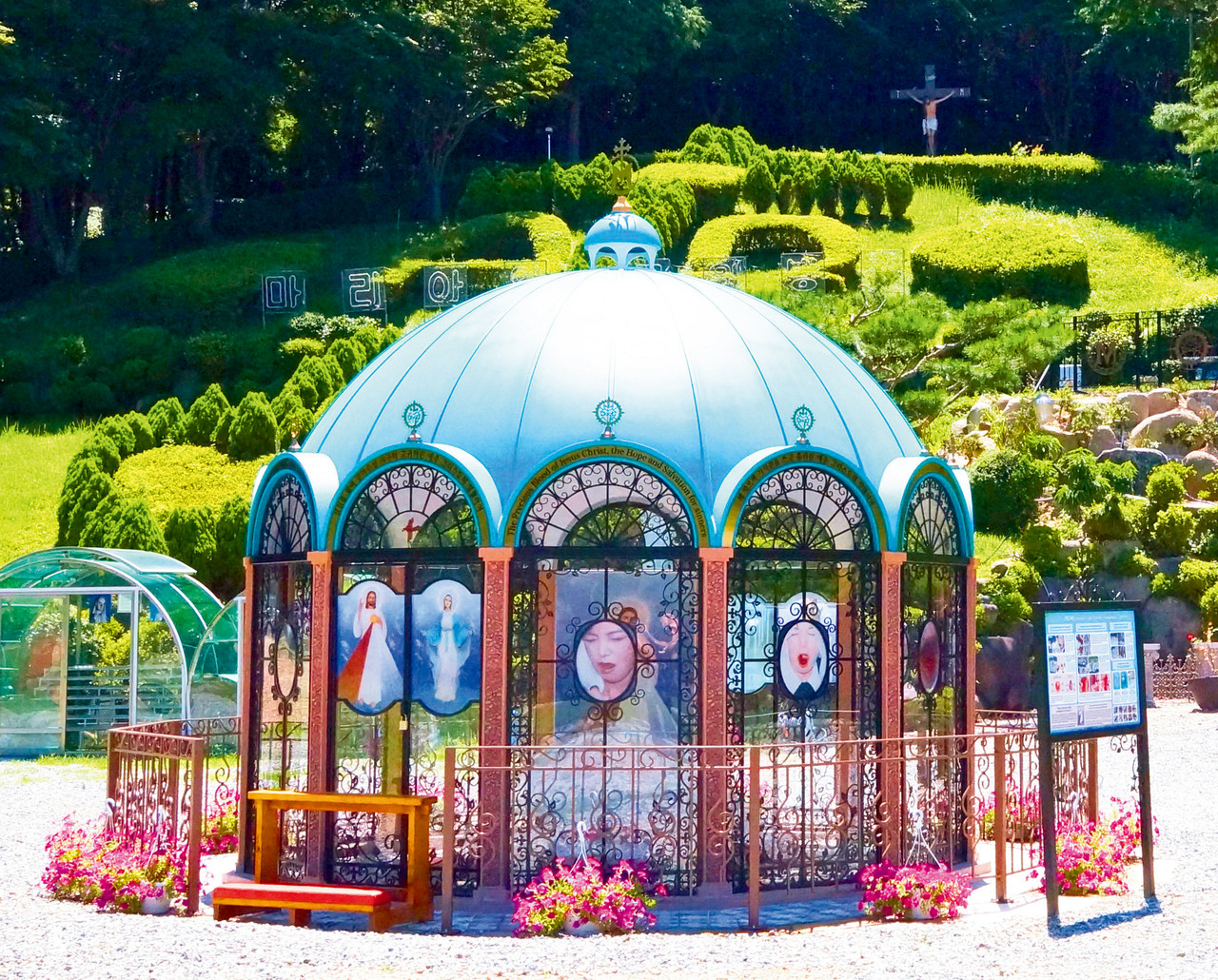
(5) Adoration Chapel of Our Lord’s Precious Blood
This is the site of two Eucharistic Miracles in 1995: one during Mass celebrated by Bishop Dominic Su from Malaysia on August 24, and another on September 22 during Mass celebrated by Bishop Roman Danylak from Canada.
A priest trained in canon law once remarked, “Since Jesus has given Eucharistic miracles here twice, it would be good to decorate the place.” Julia Kim immediately responded, “Amen.” In May 2002, twelve large stones—symbolizing the twelve apostles—and thirty-three smaller stones were arranged around the site of the Eucharistic miracle. A table was placed on top, with a photo of the miracle, so pilgrims could meditate and receive grace.
On June 11, 2002, Jesus opened His Sacred Heart and poured His Precious Blood over the stones. Julia dipped her finger into the Blood, which began to pulse visibly. Many witnesses confirmed the pulsing, and when the Blood suddenly splashed upward, the moment was captured on video, proving it was the living Blood of Jesus.
On August 15, 2002, Precious Blood from the Sacred Heart of Jesus again fell on these stones, witnessed by Bishop Dominic Su from Malaysia, Father Francis Su, Father Philip Su, and pilgrims from Malaysia, Hong Kong, Indonesia, Taiwan, Japan, Singapore, and Korea.
To preserve this holy site, an outer acrylic wall and ceiling were installed, and it was named the Adoration Chapel—the Precious Blood Prayer Room.
(6) Vinyl – Tented Chapel
To accommodate the growing number of faithful, a 300‑pyeong (991 m²) Vinyl‑Tented Chapel was constructed at the Blessed Mother’s Mountain. The first all‑night prayer meeting was held there on the first Saturday of November 2004. On November 24, 2004, the Vinyl‑Tented Chapel was consecrated, becoming a new gathering place for pilgrims.
The graces that had long flowed at the Blessed Mother House did not cease with this new chapel. Rather, they continued with even greater abundance, as Heaven desired to reassure the faithful that the Blessed Mother’s maternal love is unchanging. Pilgrims witnessed the descent of the Precious Blood of Our Lord, fragrant oil, and even milk from the Blessed Mother—manifestations that had first been experienced at the Blessed Mother House and now poured forth anew at the Vinyl‑Tented Chapel.
These supernatural signs were not mere wonders; they were channels of grace. Many hearts were converted, with souls returning to the sacraments after years of estrangement. Others experienced profound inner healing, finding peace from despair and reconciliation with God. Physical healings were also reported, as the sick regained strength and the afflicted found relief.
Thus, the Vinyl‑Tented Chapel became not only a continuation of the Blessed Mother House’s mission but also a living testimony that divine mercy and maternal love remain ever present. To this day, pilgrims gather there, drawn by faith and hope, and leave strengthened by the graces that flow unceasingly from heaven through the Blessed Mother’s intercession.